There's plenty of fish in the tank

The green tank was the first fish tank that I put in a couple of years ago and I think that I have severely overestimated the amount of fish that a small group of people would actually need. In the two main tanks there is now about a quarter of a ton of fish with the majority weighing in between the 1 and 2 kg mark.

One of the great things about Jade and Silver perch is that they are mostly herbivorous and won't eat their own young so it makes it really easy to maintain a constantly staggered production of fish by adding another hundred fingerlings to the tanks as you start to eat the larger ones.

I am ordering a fish smoker and will try it out with both the jades and silvers as I have read that these are exceptionally good fish for smoking.

So far we have only been frying the fish and have to be careful to purge the fish for a while as they can get very fatty.

I think that the main problems are that I am over feeding them and also using Barramundi feed (They didn't have bulk Perch food at the time and gave me Barra pellets for the same price) which is too high in protein.

I may start to mix their diets up a bit more with a lot more leafy greens which they love and only a small amount of pellets. Articles that I have been reading indicate that the oiliness is an advantage when smoking but so I will see how that goes.

I really want to make changes to the green tank as I made a few mistakes when setting it up. It would be nice to empty it and re-seat it on a concrete base instead of crusher dust and also raise the fiberglass grow-bed's that do all the corn production so that I can get a more reliable performance out of the auto-siphons that drain the water to the sump.

These guys really kick up a storm when you throw food in the tank. They will eat at any time of day but put on a really good show in the early morning or just on dusk.

I will take a few out this week and see if they are carrying to much body fat. They don't eat as much during winter and tend to be a lot leaner by the start of spring.


Greg Rutter

Fiberglassed Beds

I got a break in the weather and found some time to start working on the raised hydroponic beds again. The picture on the left shows what I started with and the pictures below show the end result with the food grade fiberglass gel coat on the inside and a coating of cream solar guard paint on the outside.

These things are huge and can produce substantial quantities of plants especially if the seedlings are started separately before being moved to these large beds. They can also be integrated into the gardens aquaponic systems to make use of the nutrient waste that the fish are generating.

I have been aiming to redo these beds for a while as the plastic lining was not working well. Hopefully I will get the chance to do one more before the end of the holidays but there is a lot of rain forecast so it may have to be put on hold.

I will try and get this one moved into position soon to begin production of leafy greens and will be aiming to produce enough in variety and quantity to meet the greens requirements of my extended family within the next six months.


This bed is on a bit of a slope where it currently is and is collecting water from the recent rain that we have been having so I will have to move it to flatter land. The fiberglass is a food grade resin that is used in the manufacture of water tanks and is a long lasting material but needs to be left in the open for a couple of weeks to vent of any vapours while it cures.

A net fits over the top to keep out moths but I will also be making some home made light traps to try and thin them out during the spring while they are breeding.

 Greg Rutter

Has the threat of peak oil passed?

In recent months we've seen a spate of assertions that peak oil is a worry of the past thanks to so-called "new technologies" that can tap massive amounts of previously inaccessible stores of "unconventional" oil. "Don't worry, drive on," we're told.

We can fall for the oil industry hype and keep ourselves chained to a resource that's depleting and comes with ever increasing economic and environmental costs, or we can recognize that the days of cheap and abundant oil (not to mention coal and natural gas) are over.


Quote of the Day

"And so the fact that really caught me and made me sit up and take notice is this one: somebody who is 22 years old today has been alive since half of all the oil ever has been burned. So what happens in the next 22 years, and how about the 22 years after that? 

This is a story, if you’re thinking anywhere further than just the next month or the next quarter, if you’re in charge of endowments, pensions, if you’re a leader of a country, you’re a planner of a community, if you just happen to be a concerned individual. 

I think if you stretch your view out just into these next couple of decades, there’s enough there to make you say, OOH!, maybe there’s some risks here, maybe there’s some modifications, maybe there’s some things we can do, should be doing, consider doing, that would make a lot of sense in this environment….

Planning for the future … what a concept!"

Chris Martenson

Lucas Park Meeting

Andrea and her crew hosted the August Lawn to Lunch meeting in Lucas park. This is going to be the location of Rockhampton's newest community garden and they couldn't have picked a better spot. Lucas Park is just off Musgrave st right in the middle of one of Rocky's busiest thoroughfares and is easily reached by public transport or bike to a large number of Rockhampton's residents.

The first thing you think when you look at the park from a permacultural perspective is just how perfect  a blank garden canvas it is for designing with. The park is a long rectangle running almost perfectly east-west with a bright northern exposure. Almost all of the trees are on the southern side leaving a large sunny area for raised beds.

Andrea's talk was enough to get anyone inspired about the community gardens movement and she communicated her vision of growing beyond just a park garden and starting to encompass entire streets as has been done in a lot of capital cities around the world. Growing food at a community level not only brings people closer to their food supply but also provides food for local community organization's and people struggling with costs in a economically difficult time. 

This is definitely a project that we will be continuing to follow and work with and some of our Rockhampton members have joined up to the project and hope to take part in it's establishment.

The picture on the left is the electric bike that Gwen came to the meeting on. These are becoming really popular and I hope we are going to be seeing more bikes and electrics taking over from cars for small trips around town.

Greg Rutter

Spring is here!

The maremma sheepdog has started panting which means that winter has ended and spring has arrived, all of the trees seem to be in agreement, now there is no way to escape the inevitable and desperately necessary spring cleaning that needs to be done.
GEDC0066I think that the chook pen is going to be my new favourite place to visit when the heat of summer comes around. The forage trees have burst into life and come out in their spring greens.  The original plan was to put all of the messy trees within the confines of the chicken run so that the chooks could clean up the fruit fall and and have something to do before they get let out into the rest of the yard in the afternoon.

The thick plantings have delivered a lot of additional benefits with the protection that they offer newly hatched chicks from the constant patrol of hawks above our yard. The temperature in the chook run is also pleasantly cooler then the open areas of the yard.

GEDC0064
Although we are getting lots of bananas I still think that the biggest success of the run is the cluster planting of mulberry trees. I really wasn’t sure how this would work when I planted 5 mulberry trees in a 4 square meter area but so far it is successful. I had read that mulberry trees are often selected as a hedge plant on farms so it seemed like a good choice for close plantings.

The spindly branches wind together creating a sort of  super mulberry tree that is producing a tremendous amount of fruit even though they are only a couple of years old. The main problem that I have is beating the birds to the fruit as I am not the only one who finds them a delicacy.

Last years bird netting has been grown through so at the moment I am letting the birds have what is above the netting and I get to pick everything below the netting.

GEDC0065
 GEDC0061
The last of the winter tomato vines were starting to look a little sorry for them selves so I picked what was left of the fruit and cleaned the bathtub out to take some golden corn and green bean seedlings.

One bathtub has been providing me with good number of tomatoes throughout winter and the variety ‘Yellow Perfection’ turned out to be a very pleasant snacking fruit with a sweet taste that has none of the acidic bite that you get in most varieties.

Tomato 'Yellow Perfection'
http://greenharvest.com.au/SeedOrganic/VegetableSeeds/Tomato.html


The only tomatoes that I have had success with before where the ‘Tommy Toe’ varieties as the fruit fly's were decimating everything else. I am still to find out whether the success that I had with this crop were just because they were planted in winter or whether the heavy fruit fly trapping program that I have started is beginning to have an affect.


GEDC0079
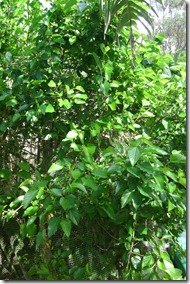
The Jaboticaba hedge has really taken off and is due for a good pruning. Spanning about 15 meters the hedge was planted to block of the view of the aquaponics water tanks that sit behind it. I decided to use Jaboticaba as it not only made an attractive hedging plant but is also an abundant producer of fruit that can be used for making your own wines and ports. It has been in for 3 years now and is doing very well but is a long way of fruiting yet.
GEDC0080When I first looked into the Jaboticaba I read that it can take up to 11 years for the plant to start fruiting. This was something that I was prepared to accept but I later found out that the fruiting times can be much shorter.

I saw an article that Rich from Happy Earth wrote about their Jaboticaba which was already fruiting after a few years, I wrote to him and asked about this and was told that if you give them deep rich soil and lots of water then they start producing a lot earlier.

This is good news to me as I planted mine in a deep trench of cow manure and they get the excess run off from the AP system which is rich in fish waste. Hopefully this means that we can look forward to some Jaboticaba Port in a few years.
GEDC0072
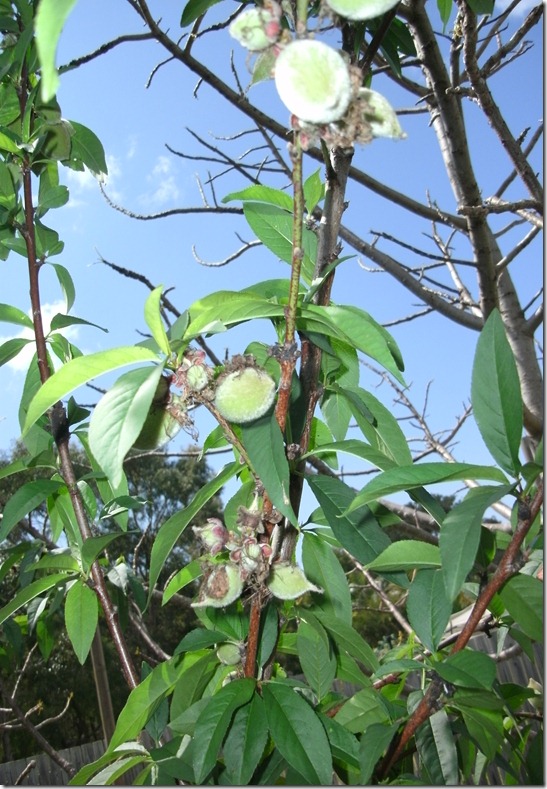
Here is attempt two at getting some peaches before the fruit fly do. Last year I was really surprised that my 2 year old low chill peach tree had already exploded in fruit. It was so heavy that I was picking off some of the fruit and disposing of it so that the young branches didn’t snap.

Unfortunately all of the mature fruit was destroyed by a fruit fly infestation and had to be thrown away. This year I stated trapping in winter to try and get ahead of the problem and used some bottle traps with ‘Wild May’ lure in them. This only attracts the male fruit fly but makes itGEDC0074 harder for the females to find a mate. I also juiced a bucket of excess lemons and added yeast, sugar and cloudy ammonia to the juice to see if that would catch the females.

The first few lots of mixture had a large number of fruit fly in them and the catch is getting less and less with each refill so either the word is getting out that you should stay away from the bottles or it is starting to have an affect.


GEDC0075 

Greg Rutter